
Automatically record SLA breaches against the right job stage
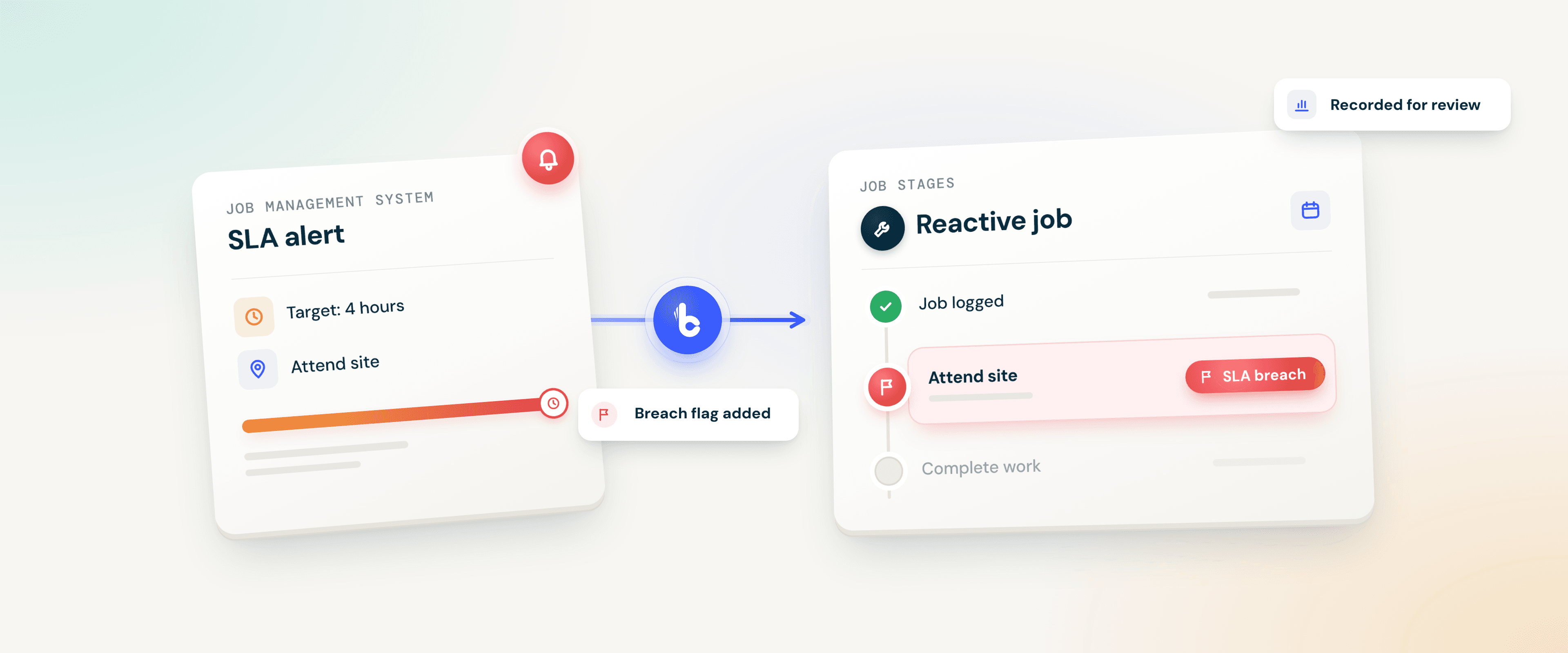
A service-level agreement (SLA) sets how quickly each stage of a job should happen, such as attending site or completing the work. When your job management system raises an SLA alert because a stage has run past its agreed time, Build Concierge finds that stage and flags it as a breach. The breach sits on the job, where your team can follow it up and report on it, rather than in an inbox.


The problem: breaches nobody can count
SLA alerts land in a shared inbox alongside everything else. Some get actioned, some get missed, and none are recorded against the job. At month-end, someone works back through timestamps to calculate response times by hand.
Then the client's monthly report arrives, and the performance conversation starts from their numbers rather than yours.
How it works
Your job management system decides when a stage has breached. Build Concierge records the breach.
- Your system raises the alert. Your job management system identifies that a stage has passed its agreed time and sends an SLA alert to your Build Concierge inbox.
- Build Concierge finds the stage. It reads the reference in the alert to identify the exact stage it relates to.
- The breach is flagged. That stage is given your SLA breach flag in the job management system. The job's dates and status are not changed.
- Exceptions come to a person. If the stage can't be identified or the flag can't be added, an email goes to your chosen contact with the reference and the reason, so someone can check it and add the flag by hand.
Illustrative example
A reactive job has a four-hour attendance target. Four hours pass without attendance, and your job management system sends its SLA alert. Build Concierge flags the attendance stage as a breach on that job. Your helpdesk sees the flag and contacts the engineer and the client, and the breach is already recorded for the month-end review.
What it covers
Coverage follows your alerts. Breaches are flagged for the stages your job management system sends SLA alerts for. A stage without an alert won't be flagged, so set alerts for the stages each contract measures.
One consistent flag. Every breach carries the same flag, so you can use your job management system's existing filters and reports to pull breaches together for a client review.
Recording, not monitoring. Build Concierge doesn't track deadlines itself or prevent breaches. It records the breaches your system alerts on, and tells a person when it can't.
Getting set up
You'll need a job management system that sends SLA alerts by email, an SLA breach flag set up in that system, and API access so Build Concierge can add the flag.
- Review your alerts. Your Customer Solutions team looks at the SLA alerts your system sends today and the stages they cover.
- Agree the flag. We use an existing SLA breach flag, or help you set one up.
- Connect and route. We connect your job management system, storing your API details securely, and your SLA alerts are sent or forwarded to your Build Concierge inbox.
- Choose your contact. Decide who receives the email when a breach can't be flagged automatically.
- Test, then go live. We run a test alert, check the flag appears on the right stage, then switch it on.
Worth knowing
A breach is when a job stage, such as attending site or completing the work, takes longer than the time agreed with the client in the service-level agreement.
Yes, as long as your job management system sends an SLA alert for that stage.
Recording every breach against the job and stage gives you your own record to compare with the client's report, instead of relying on theirs.
Yes. Talk to your Customer Solutions team about adding SLA alerts for further stages and routing them to Build Concierge.
No. Your agreed times and alert settings stay in your job management system, exactly as you've set them.
Existing customers can speak to their Customer Solutions team about running this on their SLA alerts.
More from the knowledge centre
Get alerts when purchase order lines change on invoiced jobs
When someone updates a purchase order (PO) line, Build Concierge checks whether the job it belongs to has already been invoiced. If it has, the people you choose receive an alert showing what changed, who changed it and links to the job and the PO. Your team can review the change while it's recent, rather than coming across it at month-end.

Turn emailed hire requests into hire contracts automatically
When a customer emails your hire desk, Build Concierge reads the request and any attachments. It then matches the customer, delivery site and equipment, and creates a hire contract in your hire management system. Your hire desk checks and confirms the contract instead of keying it in from scratch. Requests it can't match with confidence come to your team instead.

Automatically score tenders before you decide to bid
When your team completes a tender assessment, Build Concierge totals the scores, applies the threshold you've agreed and saves a Bid or No Bid recommendation to the tender record. Your team still scores the tender and still makes the decision. The automation makes sure every assessment is added up and measured against the same bar.

Add approved leave to engineer diaries automatically
When a manager approves leave in your HR system, Build Concierge adds the absence to the right engineer's diary in your job management system, with the correct dates and absence type. Leave is still requested and approved in your HR system as it is today. Your schedulers see who's away before they plan the week, without anyone copying it across.

Flag high risk jobs as they arrive
Put jobs that need a closer look in front of the right person. Build Concierge scores incoming job notifications against your chosen risk factors, then flags jobs that reach your threshold and alerts the owner.

Automate engineer compliance feedback
Give every engineer feedback they can act on, with their manager kept informed. Build Concierge turns completed compliance audits into personalised feedback: what went well, where to improve, anything urgent and a clear action plan. The engineer receives an email, their manager gets the same summary, and every section is saved back to the job.

Get alerts when purchase order lines change on invoiced jobs
When someone updates a purchase order (PO) line, Build Concierge checks whether the job it belongs to has already been invoiced. If it has, the people you choose receive an alert showing what changed, who changed it and links to the job and the PO. Your team can review the change while it's recent, rather than coming across it at month-end.
Turn emailed hire requests into hire contracts automatically
When a customer emails your hire desk, Build Concierge reads the request and any attachments. It then matches the customer, delivery site and equipment, and creates a hire contract in your hire management system. Your hire desk checks and confirms the contract instead of keying it in from scratch. Requests it can't match with confidence come to your team instead.
Automatically score tenders before you decide to bid
When your team completes a tender assessment, Build Concierge totals the scores, applies the threshold you've agreed and saves a Bid or No Bid recommendation to the tender record. Your team still scores the tender and still makes the decision. The automation makes sure every assessment is added up and measured against the same bar.
Add approved leave to engineer diaries automatically
When a manager approves leave in your HR system, Build Concierge adds the absence to the right engineer's diary in your job management system, with the correct dates and absence type. Leave is still requested and approved in your HR system as it is today. Your schedulers see who's away before they plan the week, without anyone copying it across.
Flag high risk jobs as they arrive
Put jobs that need a closer look in front of the right person. Build Concierge scores incoming job notifications against your chosen risk factors, then flags jobs that reach your threshold and alerts the owner.
Automate engineer compliance feedback
Give every engineer feedback they can act on, with their manager kept informed. Build Concierge turns completed compliance audits into personalised feedback: what went well, where to improve, anything urgent and a clear action plan. The engineer receives an email, their manager gets the same summary, and every section is saved back to the job.
Get alerts when purchase order lines change on invoiced jobs
When someone updates a purchase order (PO) line, Build Concierge checks whether the job it belongs to has already been invoiced. If it has, the people you choose receive an alert showing what changed, who changed it and links to the job and the PO. Your team can review the change while it's recent, rather than coming across it at month-end.
Turn emailed hire requests into hire contracts automatically
When a customer emails your hire desk, Build Concierge reads the request and any attachments. It then matches the customer, delivery site and equipment, and creates a hire contract in your hire management system. Your hire desk checks and confirms the contract instead of keying it in from scratch. Requests it can't match with confidence come to your team instead.
Automatically score tenders before you decide to bid
When your team completes a tender assessment, Build Concierge totals the scores, applies the threshold you've agreed and saves a Bid or No Bid recommendation to the tender record. Your team still scores the tender and still makes the decision. The automation makes sure every assessment is added up and measured against the same bar.
Add approved leave to engineer diaries automatically
When a manager approves leave in your HR system, Build Concierge adds the absence to the right engineer's diary in your job management system, with the correct dates and absence type. Leave is still requested and approved in your HR system as it is today. Your schedulers see who's away before they plan the week, without anyone copying it across.
Flag high risk jobs as they arrive
Put jobs that need a closer look in front of the right person. Build Concierge scores incoming job notifications against your chosen risk factors, then flags jobs that reach your threshold and alerts the owner.
Automate engineer compliance feedback
Give every engineer feedback they can act on, with their manager kept informed. Build Concierge turns completed compliance audits into personalised feedback: what went well, where to improve, anything urgent and a clear action plan. The engineer receives an email, their manager gets the same summary, and every section is saved back to the job.